Why Choose Thymosin Alpha-1 (Thymalfasin)?
Thymosin Alpha-1 (Tα1), known by its International Nonproprietary Name (INN) thymalfasin, is a synthetic 28-amino-acid peptide that has been extensively studied for its pleiotropic immunomodulatory properties . It is a well-established biological response modifier with a clinical history spanning decades, approved for therapeutic use in over 30 countries worldwide . Understanding its distinct origins and mechanisms provides important context for researchers exploring immune system modulation.
The History & Origins
Thymosin Alpha-1 was first isolated and characterized in 1977 by Dr. Allan Goldstein and his colleagues from calf thymus tissue . Its discovery was the culmination of research into the immunological function of the thymus, which began in the 1960s . The peptide was initially isolated from a crude bovine thymus extract known as “thymosin fraction 5” (TF5), which had demonstrated the ability to restore immune function in thymectomized mice . Tα1 was found to be significantly more active than the crude fraction, exhibiting 10 to 1000 times the potency in various assays .
Tα1 is a highly conserved peptide, meaning its amino acid sequence is similar across many mammalian species, underscoring its biological significance . Intriguingly, Tα1 is not encoded by a dedicated gene but is produced in the body as a cleavage product of a larger, chromatin-remodeling protein called prothymosin alpha . This unique origin and its highly conserved nature point to its fundamental role in biological processes . The synthetic version, identical to the human peptide, has been used for all major preclinical and clinical evaluations .
How It Works: Distinct Mechanisms
Thymosin Alpha-1 operates through a complex and multifaceted mechanism of action, centered primarily on the augmentation of T-cell function and broader immune system regulation .
Toll-Like Receptor (TLR) Agonist
A key mechanism involves the activation of immune cells through Toll-like receptors (TLRs). Tα1 has been identified as a natural agonist for TLR-2 and TLR-9 . By binding to these receptors on dendritic cells and other immune cells, it initiates intracellular signaling pathways that stimulate the immune response .
Immune Cell Maturation and Differentiation
Tα1 has a profound effect on T-cell biology. In vitro studies demonstrate it promotes the differentiation and maturation of T-cells, increasing populations of CD4+, CD8+, and CD3+ cells, which are crucial for adaptive immunity . It has also been shown to enhance the activity of natural killer (NK) cells, a key component of the innate immune system .
Cytokine and Chemokine Modulation
The peptide acts as a powerful modulator of the immune system by influencing the production of cytokines and chemokines, which are signaling molecules that coordinate immune responses . Specifically, it has been shown to stimulate the production of Th1-type cytokines such as interferon-gamma (IFN-γ) and interleukin-2 (IL-2), which are essential for an effective immune response against viruses and tumors .
Direct Effects on Infected Cells
Beyond its systemic immunomodulatory effects, Tα1 has demonstrated direct antiviral activity. It has been shown to increase the expression of Major Histocompatibility Complex (MHC) Class I and II molecules on cells . This enhanced expression improves the immune system’s ability to recognize and eliminate virally infected cells .
Quality & Specifications
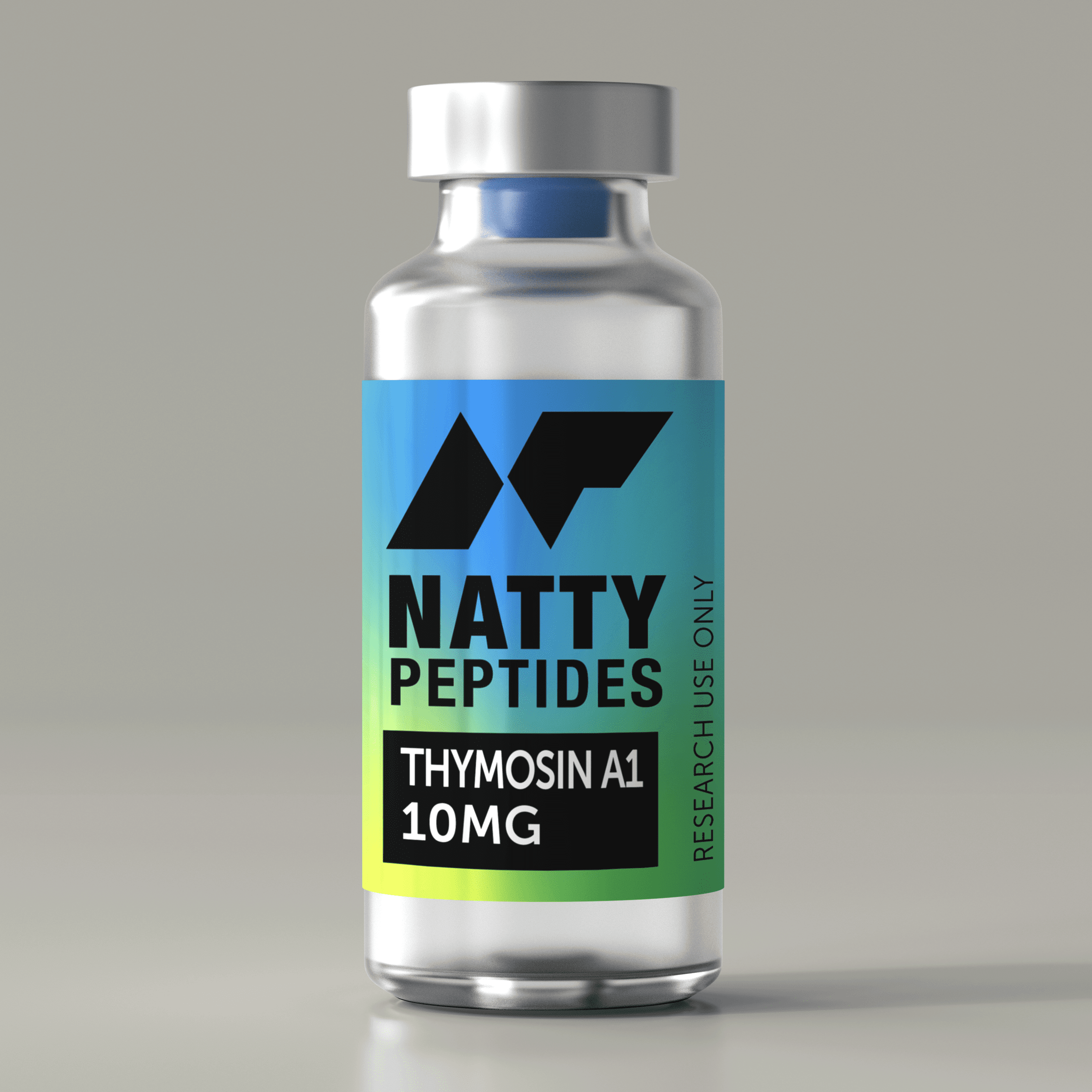
Thymosin Alpha-1 is a synthetic 28-amino-acid peptide, N-terminally acetylated, with a molecular weight of 3108 Da .
CAS Number: 62304-98-7 (confirm with supplier)
Molecular Formula: C₁₂₉H₂₁₅N₃₃O₅₅
Molecular Weight: 3108.3 g/mol
Purity: ≥98% (HPLC)
Form: Lyophilised powder
Quantity: 10mg per vial
Laboratory research compound evaluated in controlled preclinical settings. Intended strictly for laboratory and educational research applications.
For research use only.
Restricted to in vitro laboratory experimentation and cannot be used in clinical or investigational studies, applied in any medical or therapeutic context, or distributed for purposes outside regulated laboratory research.
No claims are made regarding immune function, T-cell biology, or any immunological effect