Why Choose Tesamorelin?
Tesamorelin is a synthetic peptide analogue of growth hormone-releasing hormone (GHRH), also known as growth hormone-releasing factor (GRF) . It is a 44-amino-acid peptide that is structurally identical to endogenous human GHRH, with a key chemical modification at the N-terminus that enhances its stability and resistance to enzymatic degradation . Unlike many research peptides, tesamorelin has achieved a significant milestone: it is the first and only FDA-approved treatment for the reduction of excess abdominal fat in HIV-infected patients with lipodystrophy . Understanding its distinct mechanisms and clinical profile provides important context for researchers studying metabolic and endocrine pathways.
The History & Origins
Tesamorelin was developed as a stabilized synthetic peptide analogue of the hypothalamic peptide, Growth Hormone Releasing Hormone (GHRH) . Its development was driven by the need for a targeted therapy to address HIV-associated lipodystrophy, a condition characterized by abnormal fat redistribution, insulin resistance, and metabolic complications that often arise from antiretroviral therapy (ART) . The peptide is produced synthetically and comprised of the full 44 amino acid sequence of human GRF, with a trans-3-hexenoic acid group attached at the N-terminus . This modification serves a crucial function: it confers resistance to cleavage by dipeptidyl aminopeptidase (DPP-IV), compared to the native GHRH molecule, resulting in an improved pharmacokinetic profile that allows for therapeutic efficacy with subcutaneous administration .
Tesamorelin received its first FDA approval in November 2010 under the brand name Egrifta . In 2019, it was reformulated as Egrifta SV, and in 2025, a new, more convenient formulation called Egrifta WR was approved, which requires weekly reconstitution and less than half the administration volume of the previous formulations . While FDA-approved for its specific indication, tesamorelin continues to be studied in clinical trials for its effects on body composition, hepatic fat, and metabolic outcomes .
How It Works: Distinct Mechanisms
Tesamorelin operates through a mechanism of action that is well-defined and grounded in the physiology of the growth hormone (GH) axis, making it a valuable tool for endocrine and metabolic research.
GHRH Receptor Agonist Mechanism
-
Binds and stimulates GHRH receptors — In vitro, tesamorelin binds and stimulates human GHRF (GRF) receptors with similar potency as the endogenous GHRH, acting on pituitary somatotroph cells .
-
Restores pulsatile GH secretion — By mimicking endogenous GHRH, tesamorelin stimulates the synthesis and pulsatile release of endogenous growth hormone (GH), which is both anabolic and lipolytic . This more physiological approach to augmenting GH secretion offers a favorable safety profile compared to direct GH administration .
Lipolytic and Metabolic Effects
-
Reduces visceral adipose tissue (VAT) — Through GH-mediated lipolysis, tesamorelin selectively reduces excess abdominal fat. Meta-analyses of randomized controlled trials have demonstrated significant reductions in VAT (mean difference of -27.71 cm²) and trunk fat .
-
Decreases hepatic fat — Tesamorelin has been shown to significantly reduce hepatic fat percentage (mean difference of -4.28%), an important finding for research into metabolic dysfunction-associated steatotic liver disease (MASLD) .
-
Increases lean body mass — The anabolic effects of GH stimulation result in a modest but significant increase in lean body mass (mean difference of +1.42 kg) .
Pharmacodynamic Profile
-
Effects mediated by IGF-1 — Some, but not all, of the effects of tesamorelin are primarily mediated by insulin-like growth factor-1 (IGF-1) produced in the liver and in peripheral tissues .
-
Impact on multiple target cells — GH, stimulated by tesamorelin, interacts with specific receptors on a variety of target cells, including chondrocytes, osteoblasts, myocytes, hepatocytes, and adipocytes, resulting in a host of pharmacodynamic effects .
The Synergistic Potential
Tesamorelin’s mechanism of action is complementary to other peptides involved in metabolic and tissue repair research. By acting on the GHRH receptor to stimulate pulsatile GH release, it addresses the hypothalamic-pituitary axis directly, offering a more physiological approach to modulating GH levels and its downstream metabolic effects . This is distinct from peptides that act as ghrelin receptor agonists (e.g., ipamorelin) or direct GH secretagogues.
In the context of metabolic research, tesamorelin represents a targeted approach to modulating visceral and hepatic fat accumulation, which are key factors in conditions such as HIV-associated lipodystrophy and metabolic syndrome . Its ability to reduce VAT and hepatic fat while increasing lean mass makes it a unique tool for studying the interplay between GH, adipose tissue, and metabolic health.
CAS Number: 218949-48-5
Molecular Formula: C₂₂₁H₃₆₆N₇₂O₆₈S
Molecular Weight: ~5,135 g/mol
Purity: ≥98% (HPLC)
Form: Lyophilised powder
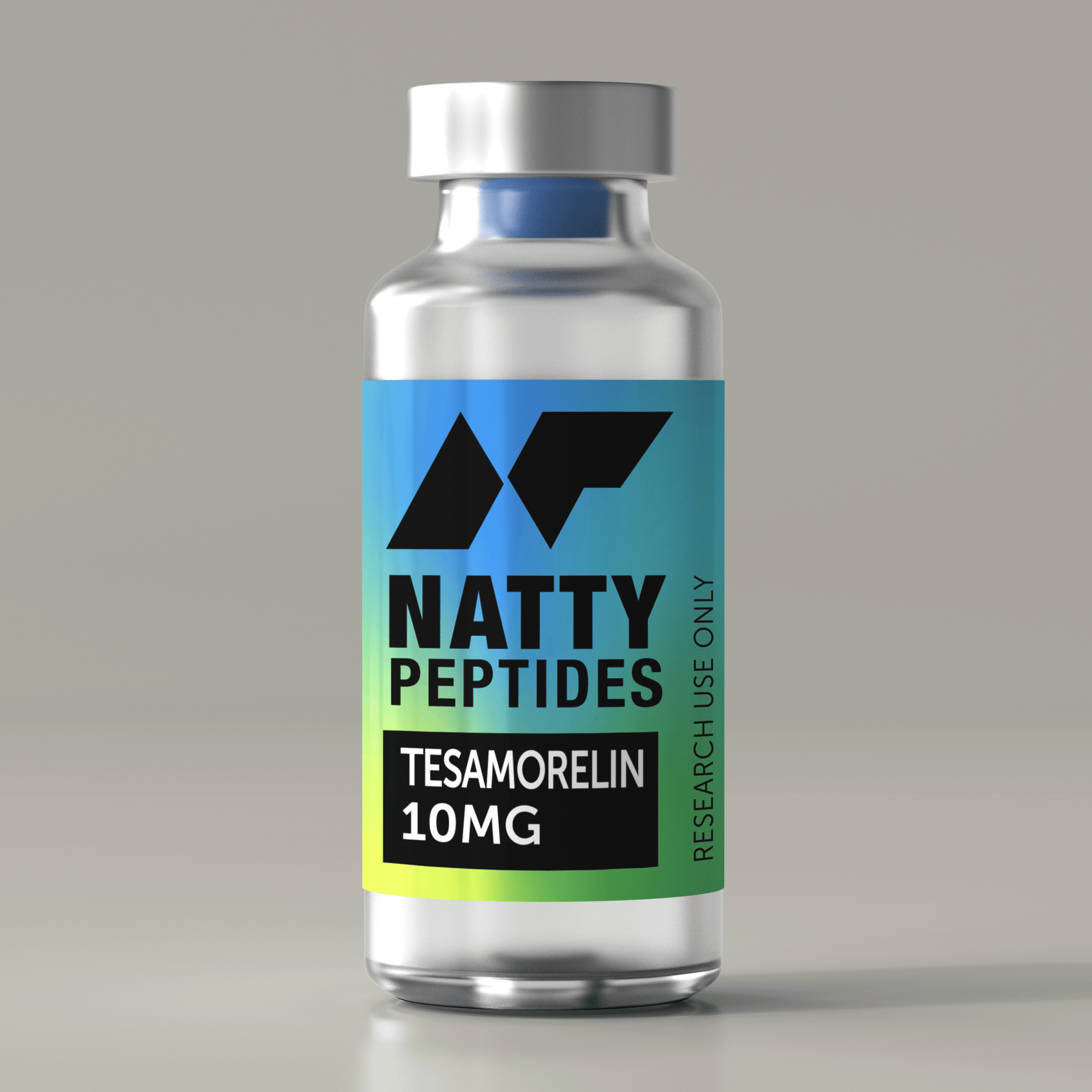
Quantity: 10mg per vial
Laboratory research compound evaluated in controlled preclinical settings. Intended strictly for laboratory and educational research applications.
For research use only.
Restricted to in vitro laboratory experimentation and cannot be used in clinical or investigational studies, applied in any medical or therapeutic context, or distributed for purposes outside regulated laboratory research.
No claims are made regarding growth hormone release, GHRH receptor activation, visceral fat reduction, body composition, or any endocrine or metabolic effect.
⚠️ NOTICE: This compound does not hold MHRA marketing authorisation in the United Kingdom and is not licensed for human therapeutic use.