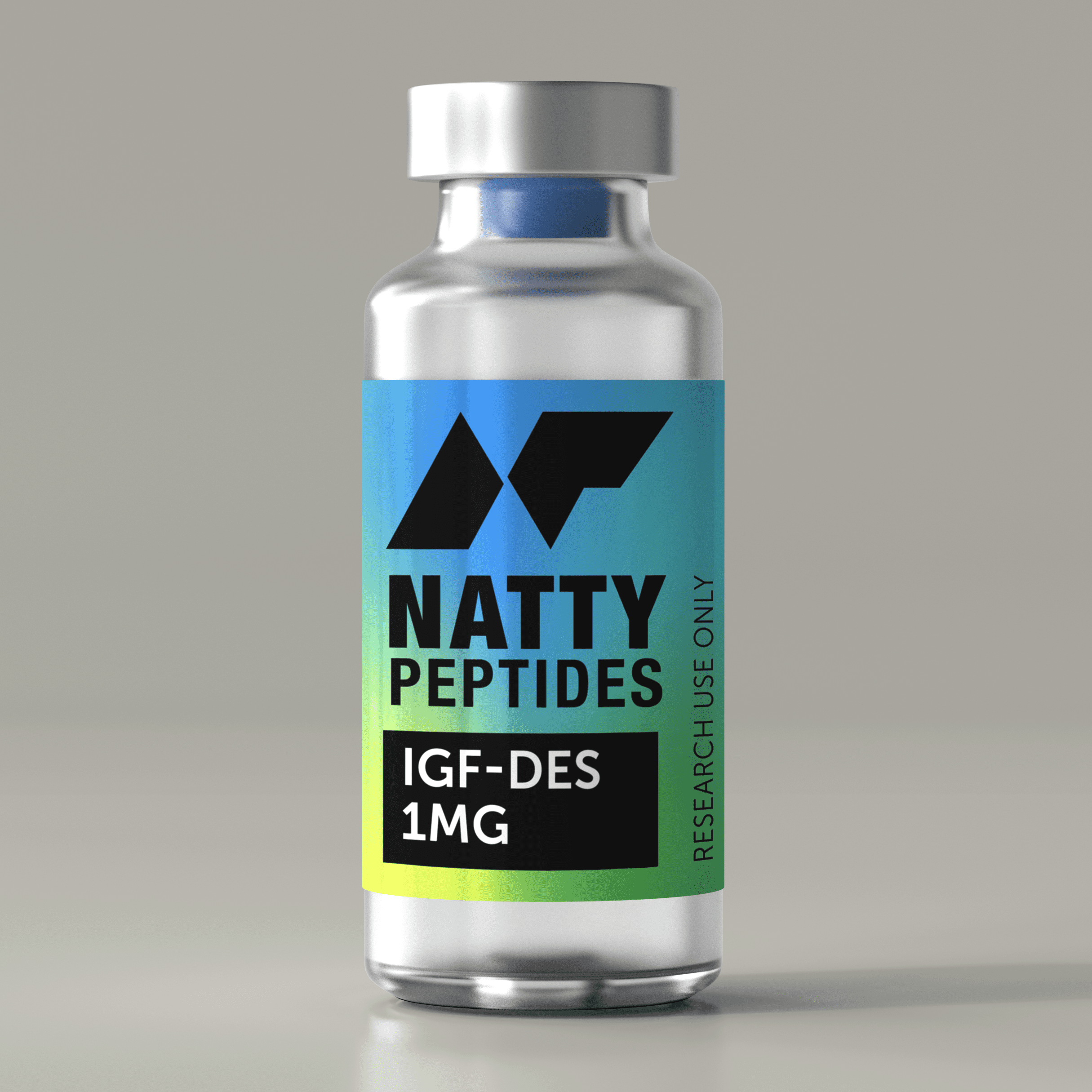
IGF-DES

£49.95

Our peptides are to be used for research only.

RESEARCH FOCUS AREAS

  • Muscle Growth: Studied for site-specific hypertrophy.
  • Recovery: Investigated for accelerated repair.
  • Performance: Explored for muscle cell proliferation.

Availability: 10 in stock

- +

What is IGF-1 DES?
Think of IGF-1 DES as a stripped-down, fast-acting version of a key growth-promoting hormone. It is a modified form of Insulin-like Growth Factor 1 (IGF-1), a natural hormone crucial for growth and repair. The “DES” stands for “Des(1-3),” meaning it has the first three amino acids removed. This simple change makes it significantly more potent and less likely to bind to proteins in the blood, allowing it to act quickly and locally.

The Main Benefits Researchers Look At:

  • Potent Localized Tissue Growth: This is the central focus. IGF-1 DES is studied for its powerful, direct ability to promote hyperplasia (an increase in the number of muscle cells) and hypertrophy (an increase in the size of muscle cells) at the specific site where it is introduced.

  • Rapid Repair & Recovery: Researchers look at its potential to dramatically accelerate the healing process of muscle tissue, tendons, and ligaments by directly stimulating satellite cells (muscle stem cells) to activate and proliferate.

  • Reduced Systemic Effects: Unlike systemic IGF-1, the DES variant is researched for its short-lived, localized action. This makes it a valuable tool for studying targeted repair without causing widespread growth effects in other organs.

  • Synergy with Exercise Models: It is a key compound in research investigating muscle adaptation, studying how a potent, localized growth signal can interact with the stimulus of mechanical exercise to enhance anabolic (building) outcomes.

How Researchers Might Use It (Site-Specific Injection with Bac Water):
Due to its purpose, IGF-1 DES is studied via very specific, often intramuscular (IM) or subcutaneous, injection protocols after reconstitution with bacteriostatic water (bac water). For localized muscle studies, IM injection is common.

Here’s a simple step-by-step of how a study might be set up:

  1. Mixing & Handling: The researcher takes a vial of IGF-1 DES (lyophilized powder) and carefully reconstitutes it with a precise amount of sterile bac water, using gentle swirling to dissolve. It is handled with care due to its potency.

  2. Injecting: Using a small syringe, a very precise, low-dose amount of the solution is injected directly into the muscle belly of interest (e.g., the gastrocnemius in a limb) or into the immediate area of a tissue injury. This is known as site-specific or localized injection.

Why This Method (Site-Specific)?

  • Direct Action on Target Tissue: The core research principle is its localized effect. Injecting it directly into a muscle or injured site ensures the compound acts predominantly in that area, allowing researchers to isolate and measure its impact on that specific tissue.

  • Short Half-Life & Minimal Spread: IGF-1 DES has a very short active life in the body (minutes). Local injection takes advantage of this, as it acts quickly on nearby cells before it can be carried away or broken down, minimizing off-target systemic exposure.

  • Models Targeted Therapy: This method is ideal for research focused on treating isolated injuries, muscle wasting in specific areas, or understanding the principles of localized growth stimulation without whole-body consequences.

  • Precision in Measurement: Researchers can then precisely analyze the injected tissue for changes in weight, fiber size, satellite cell activity, and protein synthesis rates, directly correlating the intervention with the localized outcome.

The Goal of the Research:
The primary aim is to understand the mechanisms and limits of potent, localized tissue repair and growth. Researchers use IGF-1 DES to map out the anabolic pathways in skeletal muscle and connective tissue with high precision. Studies measure increases in muscle mass and cross-sectional area at the injection site, rates of recovery from induced strains or tears, and the activation of key cellular repair machinery. The goal is to decode how a powerful, fast-acting growth signal can be applied with precision to support targeted regeneration.

In simple terms: By mixing IGF-1 DES with bac water and using a precise, site-specific injection, researchers have a powerful tool to study how this “fast-acting repair signal” can trigger rapid and potent growth and healing in a specific muscle or injured area, providing clear insights into localized regenerative processes.

IGF-DES is a shorter-acting variant of IGF-1, active primarily at the site of administration. Unlike IGF-1 LR3, which works systemically, IGF-DES is known for its powerful local effects, making it especially interesting for targeted muscle research. Studies suggest it promotes rapid muscle cell proliferation, tissue regeneration, and hypertrophy in specific areas. Researchers often highlight IGF-DES as a potent model for localised recovery and adaptation due to its ability to bypass certain binding proteins that limit IGF-1 activity. Its precision makes it a unique and valuable tool for site-specific muscle and tissue studies.

View IGF-DES Certificate of Analysis

Shopping Basket
IGF-DESIGF-DES
£49.95

Availability: 10 in stock

- +