

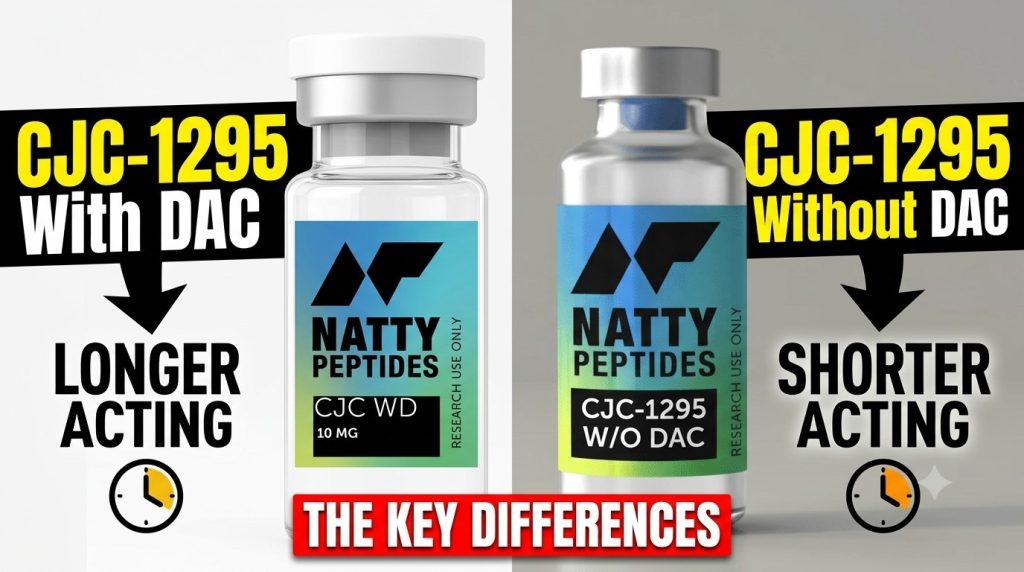
CJC-1295 is a synthetic peptide analogue of growth hormone-releasing hormone, also known as GHRH. The two forms are structurally related, but the presence or absence of the Drug Affinity Complex, or DAC, changes how they behave in research settings.
Understanding these differences can help researchers distinguish between short-acting and longer-acting CJC-1295 models.
What is CJC-1295 without DAC
CJC-1295 without DAC is also known as Modified GRF 1-29 or CJC-1295-no DAC. According to Natty Peptides, it is a 29-amino-acid peptide analogue of GHRH.
The non-DAC form does not contain the C-terminal lysine extension associated with albumin binding. Its reported half-life is approximately 30 minutes. This makes it useful in research models that examine shorter, pulsatile growth hormone signalling.
The peptide is studied for its interaction with GHRH receptors on pituitary cells and its effect on growth hormone and IGF-1 release.
What is CJC-1295 with DAC
CJC-1295 with DAC contains the Drug Affinity Complex. The DAC modification allows albumin conjugation, which extends the compound’s circulation time.
The information provided by Natty Peptides lists a half-life of around 6 to 8 days for the DAC form. This creates a longer-lasting research model compared with the non-DAC version.
The two forms therefore differ mainly in their structure, circulation time and growth hormone release pattern.
Key differences between the two forms
- The non-DAC form has a reported half-life of about 30 minutes.
- The DAC form has a reported half-life of about 6 to 8 days.
- Without DAC, research focuses on shorter, pulsatile GH signalling.
- With DAC, research focuses on sustained GH signalling.
- The DAC modification supports albumin binding.
- The non-DAC form lacks the C-terminal lysine extension linked to albumin binding.
These differences make the two compounds relevant to different types of laboratory research.
Research use and limitations
Both forms should be treated as research compounds rather than medical treatments. Natty Peptides states that its products are intended for laboratory and educational research and are not for human use.
Conclusion
The main difference between the two forms is the DAC modification. Without DAC, CJC-1295 is associated with shorter-acting, pulsatile research models, while the DAC form is studied for longer-lasting signalling. For more information about research-grade CJC-1295 products, visit Natty Peptides at www.nattypeptides.com.
FAQs
What does DAC mean in CJC-1295?
DAC stands for Drug Affinity Complex and enables albumin conjugation.
How long is the reported half-life without DAC?
The website reports an approximate half-life of 30 minutes.
How long is the reported half-life with DAC?
The website reports an approximate half-life of 6 to 8 days.
Are these products intended for human use?
No. The website states they are for laboratory research only.

