View Selank Certificate of Analysis
Why Choose Selank?
Selank is a synthetic heptapeptide developed as a novel anxiolytic and nootropic agent, distinguished from classical treatments by its lack of sedative or dependence-inducing effects . Understanding its distinct origins and multi-faceted mechanisms provides important context for researchers studying neuropeptide modulation of anxiety, cognition, and immune function.
The History & Origins
Selank is a synthetic heptapeptide with the sequence Thr-Lys-Pro-Arg-Pro-Gly-Pro (TKPRPGP) . It was developed as a synthetic analogue of the endogenous immunomodulatory peptide tuftsin (Thr-Lys-Pro-Arg), incorporating the C-terminal tripeptide Pro-Gly-Pro (PGP) to enhance metabolic stability and prolong biological activity . The peptide was developed by the Institute of Molecular Genetics of the Russian Academy of Sciences in cooperation with the V.V. Zakusov Research Institute of Pharmacology . It was registered in Russia and Ukraine as a nootropic anxiolytic, distinguished from classical benzodiazepines by its lack of sedative effects, withdrawal syndromes, or cognitive impairment .
How They Work: Distinct Mechanisms
Selank operates through a multi-pathway mechanism that distinguishes it from conventional anxiolytics like benzodiazepines, making it a unique tool for neurobiological and immunological research.
GABA Receptor Modulation: A Key Anxiolytic Mechanism
-
Positive allosteric modulator — Research has demonstrated that Selank affects [³H]GABA binding as a positive allosteric modulator of GABA receptors, one of the mechanisms underlying its anti-anxiety effects .
-
Subtype-selective modulation — The peptide’s anxiolytic mechanism is associated with subtype-selective, concentration-dependent allosteric modulation of GABA receptors, suggesting it may offer more targeted effects than classical benzodiazepines .
-
Non-benzodiazepine binding site — Selank can block the modulatory activity of diazepam and olanzapine, indicating that its binding site on GABA receptors is not the same as that of benzodiazepines, though they may partially overlap .
NMDA Receptor Interactions
-
Glycine site modulation — Selank has been shown to affect binding to the glycine site of the NMDA receptor in a brain-region-specific manner, with effects observed in both the cortex and hippocampus, suggesting engagement of the cortical NMDA glycine site in some of its pharmacological effects .
-
Route-dependent effects — Both intranasal and intraperitoneal administration of Selank have been shown to modulate NMDA glycine site binding, with effects varying by brain region (cortex vs. hippocampus) and mouse strain .
Neurotrophic and Neurotransmitter Modulation
-
BDNF expression — Selank has been found to rapidly elevate the expression of brain-derived neurotrophic factor (BDNF) in the hippocampus of rats, a key factor in neuronal plasticity and resilience .
-
Monoamine neurotransmitter modulation — The peptide influences the concentration of monoamine neurotransmitters and induces metabolism of serotonin, suggesting involvement in broader neurochemical regulation .
-
Enkephalin degradation inhibition — Selank inhibits enzymes involved in the degradation of enkephalins and other endogenous regulatory peptides, an action that may contribute to its effects .
Immunomodulatory Effects
-
Cytokine balance — Selank has been shown to modulate the expression of interleukin-6 (IL-6) and affect the balance of T helper cell cytokines . Under conditions of “social” stress, Selank reduced the concentration of pro-inflammatory cytokines IL-1β, IL-6, and TNF-α, as well as TGF-β1, nearly reaching control values .
-
Stress-protective activity — Research indicates the peptide possesses stress-protective activity, reducing the inflammatory response associated with chronic stress exposure .
Brain Network Modulation
-
Functional connectivity — Functional MRI studies have revealed that Selank affects resting-state functional connectivity between the right amygdala and the right temporal cortex, brain regions central to the regulation of anxiety and emotional processing
CAS Number: 129171-83-6 (confirm with supplier)
Sequence: Thr-Lys-Pro-Arg-Pro-Gly-Pro
Molecular Formula: C₃₃H₅₇N₁₁O₉
Molecular Weight: 751.87 g/mol
Purity: ≥98% (HPLC)
Form: Lyophilised powder
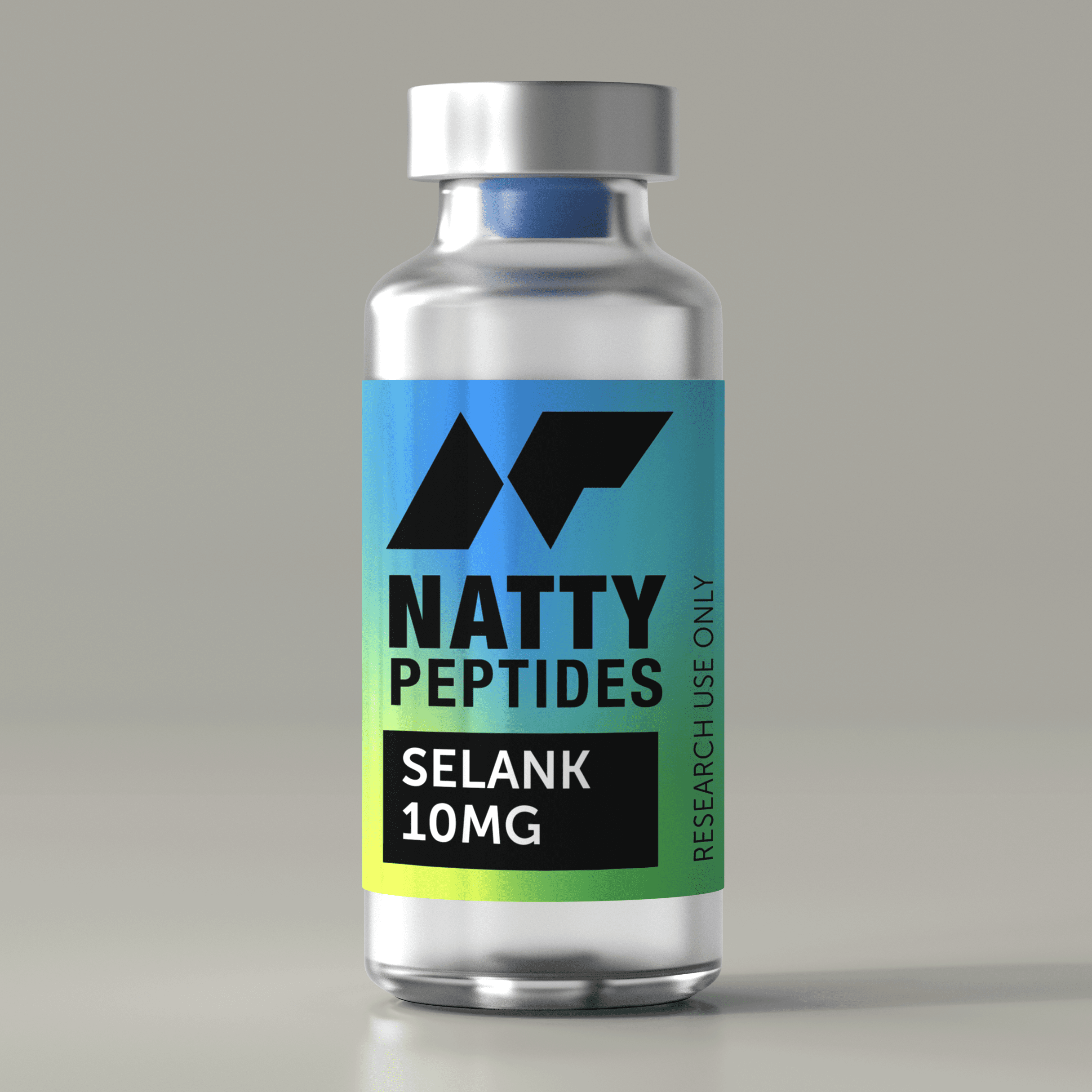
Quantity: 10mg per vial
Laboratory research compound evaluated in controlled preclinical settings. Intended strictly for laboratory and educational research applications.
For research use only.
Restricted to in vitro laboratory experimentation and cannot be used in clinical or investigational studies, applied in any medical or therapeutic context, or distributed for purposes outside regulated laboratory research.
No claims are made regarding anxiety, cognitive function, neurotransmitter modulation, mood, or any neurological or psychological effect.